Thursday, December 8, 2011

Property market slowdown: So this time's for real then?


The Singapore property market is bracing for a slowdown, with experts predicting a steep drop in transaction volume and prices over the next few months, following the latest cooling measures.

At least one real estate agency thinks the immediate reaction will be a slowdown in the private property market.

CEO of PropNex Realty Mohamed Ismail said he expects a price correction of approximately 15 to 20% in the central core region, and a correction of 10 to 15% in the mass market segment in the next six months.

PropNex also expects transaction volume for properties to dive by as much as 40% in the core central region - like Orchard and Marina Bay. This is because of the significant number of foreign buyers for such properties.

Meanwhile, PropNex expects transaction volume to fall by as much as 20% in the mass market segment.

Analysts expect buyers to adopt a wait-and-see approach.

Mr Mohamed said: "It takes a very bullish decision from a foreigner to come and invest in Singapore in today's market, having to pay a 13% stamp duty upfront, and (being) subjected to the Seller's Stamp Duty in the next four years, of 16%, 12%, 8% and 4%.

"And even if you sell after four years, if he buys a property today, he must expect at least a 25 to 30% increase in the property price to break even, taking into consideration other costs and interests and all other elements."

Under the latest changes, foreign buyers of private properties in Singapore will now have to fork out 10% more in stamp duty while permanent residents and Singaporeans are also affected with an increased stamp duty on their second and third properties respectively.

PropNex said the new measures could have been targeted to preserve affordable pricing in the mass market segment - homes costing less than $2 million where prices have surpassed $1,000psf.

It argues that having a blanket policy will impact the high-end market which has been the investment interest of the foreign buyers.

Norman Lu, a foreign buyer, said: "We are very disappointed about this rule. Because even though we are foreigners, we have been working in Singapore...we also contribute to this country. So as a foreigner, we feel that the government does not welcome us."
Source: Channel News Asia

Mr Lu may have felt hard done by our Government but then again, many countries around the world have similiar policies concerning foreign purchase of private residential properties. Maybe that's what they meant by "Citizenship has its privileges"...?

.

ABSD: Reactions from Developers & Buyers


DEVELOPERS SAY:  Mass-market and luxury homes 'will all be hit'
The measures announced yesterday will hit developers aiming for the luxury market but mass-market builders will not escape either, said analysts.

High-end developers such as SC Global and Wing Tai could see demand slip as foreigners, who generally account for more than half of the sales in the upper-price brackets, will be hit by the additional 10% stamp duty.

This is over and above the existing buyer's stamp duty of 3%.

Independent research firm Sabio Global director Alan Lok said: "Traditionally, the Chinese buyers come here because Singapore is considerably cheaper than Hong Kong, but a stamp duty of 13% is quite drastic.

"This will definitely make them (foreign buyers) think twice about buying property here."

The mass market will also feel the impact as Chinese buyers have been steadily moving into the suburbs so the stamp duty levy is likely to cool their buying.

While a decline in demand is almost certain, analysts and developers believe the measures will not do much to dampen property prices given that land is still pricey and construction costs are rising.

Property developer Roxy-Pacific executive chairman and chief executive Teo Hong Lim said: "Well, it doesn't mean that just because sales are slow, we have to sell at a loss, right? We still have to break even."

However, he does not think that the measures will affect his business very much as 50% of his pipeline is made up of commercial - mainly retail and office - units.

He also added that foreign buyers only make up about 10% of his clientele on average.

Mr Wong Heang Fine, chief executive of CapitaLand Residential Singapore, said: "Given the uncertainty in current market outlook, the latest measures on additional buyer's stamp duty were unexpected. We will study the details and take them into consideration."

While share prices of all developers are likely to slide today, Kim Eng analyst Wilson Liew believes the impact will not be that great for those with a more diversified business model.

"There will be weakness in the short term, but CapitaLand for example has significant businesses in China, and that will be a buffer for them even if their Singapore business is affected," he added.

BUYERS SAY:  First-timers cheer move; others get cold feet
Early reactions to the latest round of property market measures were mixed though the consensus seems to be that home prices will moderate.

First-time Singaporean home buyers generally cheered the move, as they believe it will now be easier for them to get a foothold on the property ladder. Many have been concerned that foreign buyers, especially those purchasing mass-market homes, have been driving prices up.

But some foreigners and permanent residents (PRs) expressed disappointment at the measures, which they labelled as "harsh".

The hardest hit will be foreigners who are not PRs. They will be slugged with an additional 10% on any home purchase, on top of the existing stamp duty of about 3%.

For a foreigner buying a $1 million home, the stamp duty will jump significantly to $124,600 from $24,600.

PRs will also be slapped with a 3% additional stamp duty for their second and subsequent home purchases while Singaporeans will face the same charge only for their third and subsequent buys.

Property agents say that foreign buyers are likely to put any home purchases on hold in anticipation of prices dropping as the new measures take effect.

Some agents have already reported deals falling through in the first few hours after the measures were unveiled.

PropNex chief executive Mohamed Ismail said that two of his firm's foreign clients pulled out of separate deals at Marina Bay Residences. Another backed out of a deal for an Orchard Road property.

"Although one was already at his third viewing and will be unaffected if he closed the deal by today, he saw no pint because prices might drop," he said.

Mr Ismail added that the measures did not seem to be "well thought through" as their blanket application will adversely affect the high-end market in particular.

He suggested that the additional buyer's stamp duty be applied in a more targeted manner instead. For example, it could be applied to mass-market homes of less than $1,500psf so that the segment remained largely for Singaporean buyers, he said.

A Chinese buyer who wanted to be known as Mr Chen said that he was surprised at how "harsh" the new rules were. He had flown in from Shanghai last week to visit some friends but also to explore the possibility of buying a home in the prime districts of 9, 10 and 11.

He said that he would put his plans on hold until the market situation became clearer.

However, first-time Singaporean buyers and upgraders like human resource executive Germaine Lim welcomed the news, which they hope will bring prices down.

Ms Lim, 29, said: "Hopefully, without foreigners competing with us, we can finally find something within our budget."
Source: The Straits Times

.

Wednesday, December 7, 2011

Just when you think the property market cannot be "cooler"...


The government has imposed an Additional Buyer's Stamp Duty (ABSD) for private property of between 3% and 10% for Singaporeans, Permanent Residents and foreigners to moderate investment demand for private residential property and promote a more stable and sustainable market.
The changes take effect on December 8.

Foreigners will pay 10% Additional Buyer's Stamp Duty (ABSD) for any residential property.

Permanent Residents owning one and buying second and subsequent properties will pay 3% ABSD.

Singaporeans owning two and buying a third and subsequent residential properties will pay 3% Additional Buyer's Stamp Duty.

The ABSD will be imposed over and above the current Buyer's Stamp Duty, which are 1% on the first $180,000 of purchase consideration or market value of the property (whichever is higher), 2% on the next $180,000 and 3% for the remainder.

In a joint statement on Wednesday, the Finance and National Development ministries say the government's objective is to promote a sustainable residential property market where prices move in line with economic fundamentals.

They said prices of private residential properties have continued to rise, albeit more slowly in the last two quarters.

Prices are now 13% above the peak in the second quarter of 1996, and 16% above the more recent peak in the second quarter of 2008.

They said that even with the current economic uncertainties, the demand for private residential property remains firm.

Given the uncertainty in stock markets and with interest rates remaining low, private property in Singapore continues to attract local and foreign investors.

They added that excessive investment demand will make the property cycle more volatile, and thus increase the risks to Singapore's economy and banking system.

The government said the higher ABSD rate for foreign buyers in particular is necessary, in view of the large pool of external liquidity and strong buying interest from abroad, and the relatively small size of the Singapore market.

The government said foreign purchases account for 19% of all private residential property purchases in the second half of 2011, up from 7% in the first half of 2009.

For purchases made jointly by two or more parties (eg a Singaporean with a PR, or a PR with a foreigner), the higher applicable ABSD rate will be imposed.

For example, if a citizen purchases a property with a foreigner, the ABSD of 10% will apply.

In the case of a joint purchase by Singaporeans, who each already owns properties, the ABSD of 3% will apply as long as one of the purchasers already owns two properties.

Deputy Prime Minister and Minister for Finance Tharman Shanmugaratnam, said: "We have always had open markets and must keep them that way. However, the reality is that investment flows into our property market are now larger than before, and unlikely to recede as long as interest rates remain low.

"The additional buyer's stamp duty should help cool investment demand, and avoid the prospect of a major, destabilising correction further down the road."

Nicholas Mak, Executive Director of Research and Consultancy at SLP International, said: "It will curb investment demand for private residential properties quite drastically, especially demand from non-resident foreigners. And I think in the next one to two months or so, demand from non-resident foreigners will almost dry-up."

Home buyers are mixed in their views.

One Indian foreigner said: "I know there is a stamp duty, but any increase in that will probably take it out of my level where I want to buy."

An Indian who is a Permanent Resident said: "Nowadays, HDB properties are also difficult to buy, because of more conditions. So they have to buy property here. Definitely they'll keep buying more irrespective of whether the stamp duty is increased or not."

One Singaporean said: "It probably wouldn't have an effect in the short-term, because the property market prices are still rising, people are still speculating."

Minister for National Development Khaw Boon Wan said: "We are ramping up the supply of new Executive Condominium units through the Government Land Sales Programme.

"This will help higher-income Singaporeans own private condominium units in an affordable way, as the sale of new EC units is restricted to Singaporean households only."

Singaporean first-time buyers and upgraders, and buyers of HDB flats will not be affected by the new measure.

Certain reliefs will be provided so that the measure will not impact home occupation demand by residents.

For example, relief will be provided for Singaporean-foreigner/PR married couples buying their homes.

Reliefs will also be provided for qualifying developers and for purchases falling within the scope of Singapore's international trade agreements.

The government will continue to ensure an adequate supply of private housing to meet-medium term demand.

There are 41,000 unsold private housing units in the pipeline.

The government will inject sites that can potentially yield a total of 14,100 units in the 1H2012 Government Land Sales (GLS) Programme, similar to the supply in previous GLS programmes.

Of these, about 7,000 units will be from sites on the Confirmed List.

These numbers take into account the ample pipeline supply and the dampening effect of the ABSD.

The government will also expand the supply of executive condominiums (ECs) in 2012 and is prepared to release sites that can potentially yield 5,000 EC units for the entire year.

Sites for 3,500 EC units will be made available in 1H2012, including 3,000 EC units on the Confirmed List.

The Confirmed List quantum is comparable to the 3,000 EC units from five sites sold for the whole of 2011. More details will be provided in the press release for the 1H2012 GLS Programme on MND's website.

The Government will continue to monitor the property market and adjust its property policies in step with changes in the market and the economy.
Source: Channel News Asia

The wife and I have just returned from our short family vacation (literally that is, since we have only touched down like two hours ago) and this is the first piece of property news we happened to chance upon. 

The Additional Buyer's Stamp Duty (ABSD) should appease (somewhat) those who are worried by the increasing number of private home purchases by foreigners, which they claimed have driven up property prices. It will also help to dampen the flow of "hot money" into our private property sector (which is probably the larger factor in driving up prices), given the current double-whammy of much higher buying and selling stamp duties. 

And for Singaporeans that already own two private residential properties and wanting to buy a third, we reckon they should not complaint (too much) about the ABSD.

So maybe the government is finally listening, as they said they would...  


.
Tuesday, December 6, 2011

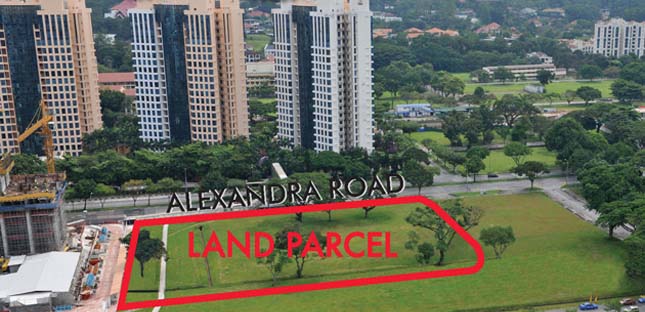
Tender for GLS site at Alexandra Road closed with 7 bids


The tender for the development of a residential site at Alexandra Road closed on Tuesday with seven bids, the Urban Redevelopment Authority (URA) said.

The top bid of $396 million was jointly submitted by Sunmaster Holdings, Intrepid Investments and Garden Estates Limited. These are units of City Developments, Hong Leong Group and Hong Realty respectively.

The bid translates to $8,120.08 per sq m.

Tanglin Land submitted the second highest bid of $363 million, while Sherwood Development sent the third highest bid of $339.5 million. The lowest bid of $318.3 million was handed in by Multi Wealth (Singapore).

While the number of bids was fewer than analysts had expected, the margins between the bid prices were slim. The top bid was only 9.1% and 16.6% higher than the second and third highest bids.

"The keen interest and bidding by the consortium is spurred by the rare availability of an attractive site situated in a convenient and established location at the city fringe area that is generally popular with homebuyers/investors," said Ms Chia Siew Chuin, Director of Research & Advisory at Colliers International.

Analysts estimate the breakeven price for the site is around $1,300 psf.

Mr Li Hiaw Ho, Executive Director at CBRE said developers can build a high-rise project of over 40 storeys of some 550 apartments at the 99-year lease site.

Launched on October 17, the property measures 9,952.6 sq m with a maximum permissible gross floor area (GFA) of 48,768 sq m. It is located near the Redhill MRT station.

URA said it will award the tender after evaluating the bids.
Source: Channel News Asia

According to previous reports, the said site has a plot ratio of 4.9 and a maximum GFA of 524,936 sq ft, yielding between 540 and 580 units in a development that can be built up to 45 storeys.

Units at the neighbouring condo project Ascentia Sky were reportedly transacted at an average price of $1,381psf in the last six months, while units at Metropolitan Condominium, 100m away, transacted at $1,313psf. 


.

Monday, December 5, 2011

Fewer high-end home deals, non-PR foreigners' purchase up

Transactions in Singapore's high-end residential market, such as up-market apartments/condos in choice districts and bungalows on Sentosa Cove, have fallen this year, but non-permanent resident foreigners' share has gone up for both categories of properties, according to Savills Singapore.

Analysts attribute the increase partly to mainland Chinese fleeing restrictions on property buying in their home market and instead parking their monies in Singapore's property market. As well, some investors may be inclined to escape the economic gloom in Western economies and to favour the relatively healthier economies in Asia. Singapore stands out as a property buying destination in Asia for its transparency, political stability and relative safety.

Savills' analysts found that in the first 11 months of this year, 1,285 caveats were lodged for apartments and condos in districts 1, 4, 9, 10 and 11 priced at least $2,000psf of strata area - down 33% from the same year-ago period. The figure for full-year 2010 was 2,156.

However, non-PRs' share of purchases of non-landed homes in these five districts priced at over $1,951psf (or $21,000 per sqm) has increased from 28.4% last year to 37.8% in the first 11 months of 2011.

The latest figure surpasses the 31.1% in 2007 and 33.2% in 2008 - during the earlier foreign buying frenzy. Savills' analysis, which was based on URA Realis caveats data as of Nov 30, also showed that on the total foreign buying pool (PRs and non-PRs combined), Indonesians have been the top buyers since 2007.

Their share of the total number of caveats (including purchases by Singaporeans and companies) edged up from 15.4% in full-year 2010 to 16.4% during the Jan - Nov 2011. However, the 236 upmarket apartments/condos they have bought this year is about 35% shy of the 363 units they acquired in full-year 2010.

On the other hand, the number of upmarket apartments picked up by mainland Chinese has risen from 136 for full-year 2010 to 170 in Jan - Nov 2011. Their share of total buying also doubled from 5.8% to 11.8%.

A longer-term comparison reflects a similar picture. The number of high-end apartments bought by Indonesians has roughly halved from 438 in 2007 to 236 in Jan - Nov 2011, while the number of caveats lodged by mainland Chinese has quadrupled from 43 to 170.

Indians - who did not even feature among the top five nationalities of foreign buyers in 2007 - were the fourth largest foreign buyers of high-end apartments in Jan - Nov 2011, with 31 caveats or a 2.2% share of total purchases.

Credo Real Estate executive director Ong Teck Hui observed that traditionally Indonesians have been the predominant buyers of high-end apartments in Singapore. But recently, the Chinese and Indians have increased their presence in this segment, as wealth levels rise on the back of strong economic growth.

As well, property buying curbs in China are driving some mainland Chinese to park monies in Singapore, he added.

Over at Sentosa Cove (where foreigners don't need to be PRs to qualify to buy landed homes), the Chinese are the biggest foreign buyers (PRs and non-PRs combined) of bungalows. They purchased five of the total 20 bungalows transacted in Jan - Nov this year. Singaporeans bought eight bungalows.

As a whole, non-PR foreigners picked up seven bungalows in the upscale waterfront housing district in Jan - Nov 2011, giving them a 35% share of total purchases, up from their 33.3% share in full-year 2010.

Savills' analysis found that the average price of bungalows transacted in Sentosa Cove has risen 11.1% from $1,910psf of land area for full-year 2010 to $2,122psf for Jan - Nov 2011. In absolute dollar quantum, the average price per bungalow transaction has appreciated 7.7% from $17.1 million to $18.4 million. The total number of Sentosa Cove bungalows transacted has slipped from 54 last year to 20 in Jan - Nov 2011.

Steven Ming, executive director of Savills Prestige Homes, expects transaction activity in Singapore's high-end residential sector to remain subdued in the next few quarters against the backdrop of a turbulent global economy.

"But the market should continue to attract regional and global high net worth clientele interest, as they look for safe havens to store their wealth. Singapore is one of the two AAA-rated countries in Asia," he added.
Source: The Business Times

It is still not too late to learn Mandarin, or employ more Mandarin-speaking staff for that matter...

.